



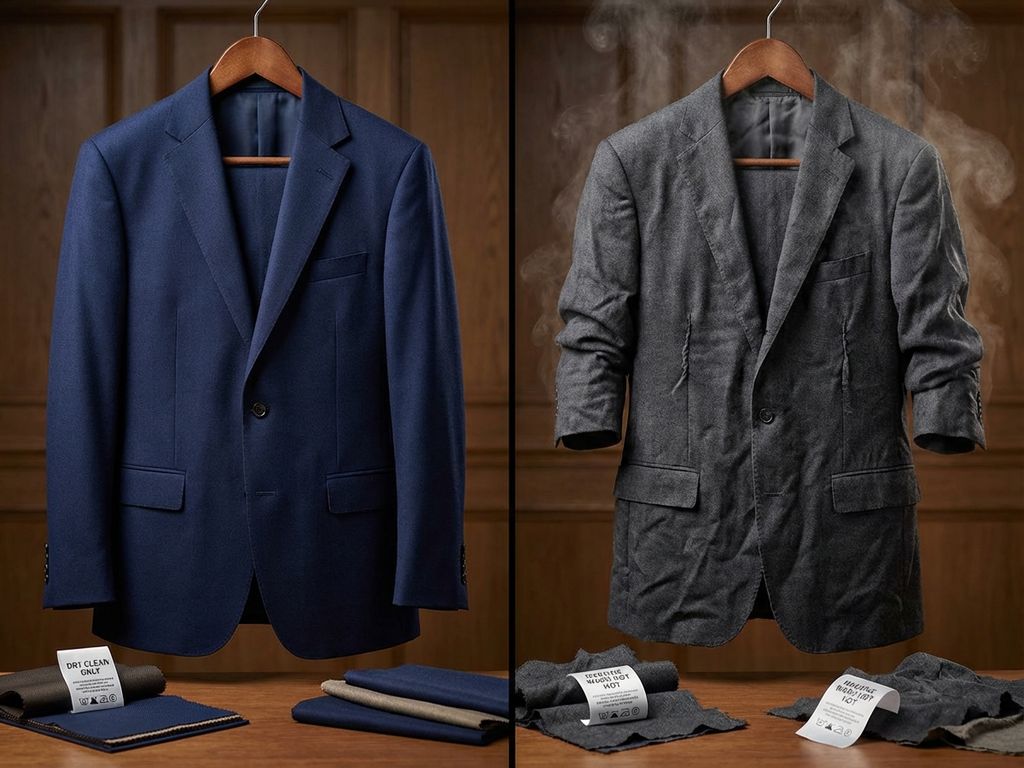
Le rétrécissement du tissu du costume se produit lorsque les fibres se contractent sous l'effet de la chaleur, de l'humidité et des contraintes mécaniques lors du nettoyage ou du port. Les fibres naturelles comme la laine et le coton sont plus sujettes au rétrécissement que les matières synthétiques en raison de leur structure cellulaire. La qualité de la construction du tissu, les processus de prétraitement et les techniques de finition influencent considérablement la capacité d'un costume à conserver sa taille et sa forme d'origine.
Qu'est-ce qui provoque le rétrécissement des tissus des costumes ?
Le rétrécissement du tissu se produit lorsque les fibres individuelles se contractent et que la structure du tissu devient plus compacte. Ce phénomène est dû au fait que la plupart des fibres naturelles ont une structure cellulaire qui réagit aux changements de température et d'humidité. Lorsqu'elles sont exposées à la chaleur et à l'humidité, ces fibres absorbent l'eau, gonflent, puis se contractent en séchant, resserrant ainsi la structure du tissu.
La structure du tissage joue un rôle crucial dans l'ampleur du rétrécissement d'un tissu. Les tissus à tissage lâche laissent plus de place aux fibres pour se déplacer et se contracter, tandis que les tissus à tissage serré offrent une meilleure stabilité dimensionnelle. La tension du fil au cours de la fabrication influe également sur le potentiel de rétrécissement : les fibres soumises à une forte tension au cours du tissage sont plus susceptibles de se détendre et de se contracter lorsqu'elles sont exposées à la chaleur et à l'humidité.
Les fibres naturelles se comportent différemment des fibres synthétiques en raison de leur origine et de leur structure. Les fibres de laine ont des écailles à leur surface qui peuvent se bloquer lorsqu'elles sont agitées dans des conditions chaudes et humides, ce qui entraîne un rétrécissement permanent. Les fibres de coton contiennent de la cellulose, qui absorbe l'humidité et provoque le gonflement puis la contraction des fibres. Le lin, fabriqué à partir de fibres de lin, possède des propriétés similaires à celles du coton, mais tend à être plus stable en raison de la longueur plus importante de ses fibres.
Fibres synthétiques comme le polyester et le nylon sont fabriqués selon des dimensions spécifiques et n'absorbent pas l'humidité comme le font les fibres naturelles. Elles sont donc beaucoup plus résistantes au rétrécissement, bien qu'elles puissent encore être affectées par des températures très élevées susceptibles de modifier la structure du polymère.
Quels sont les tissus des costumes les plus susceptibles de rétrécir et pourquoi ?
La laine est le tissu le plus susceptible de rétrécir, en particulier la laine non traitée ou mal traitée. Les écailles naturelles des fibres de laine s'imbriquent les unes dans les autres lorsqu'elles sont exposées à la chaleur, à l'humidité et à l'agitation, ce qui provoque un rétrécissement permanent irréversible. Les laines légères et celles dont le tissage est lâche sont particulièrement vulnérables aux variations dimensionnelles.
Le coton et les mélanges de coton rétrécissent également facilement car les fibres de coton se contractent naturellement lorsqu'elles sont mouillées et séchées. Les costumes en coton pur peuvent rétrécir considérablement, surtout s'ils n'ont pas été pré-rétrécis lors de la fabrication. Le rétrécissement se produit généralement au cours des premiers cycles de nettoyage et affecte à la fois la longueur et la largeur.
Les costumes en lin présentent un risque modéré de rétrécissement. Bien que les fibres de lin soient généralement plus stables que celles du coton en raison de leur longueur et de leur structure, le lin non traité peut tout de même rétrécir sensiblement. Les irrégularités naturelles du tissage du lin peuvent s'accentuer après le rétrécissement, ce qui affecte le drapé et la coupe du costume.
Poids du tissu et densité du tissage ont un impact significatif sur la résistance au rétrécissement. Les tissus plus lourds au tissage plus serré rétrécissent généralement moins que les matériaux légers au tissage plus lâche. Les tissus en laine Super 150 et plus, bien que luxueux, sont souvent plus délicats et sujets à des changements dimensionnels que les laines plus robustes et de moindre qualité.
Les mélanges synthétiques et les tissus purement synthétiques sont ceux qui rétrécissent le moins. Les mélanges polyester-laine rétrécissent généralement moins que la laine pure car les fibres synthétiques assurent la stabilité. Toutefois, la composante en fibres naturelles peut encore provoquer des changements dimensionnels, en particulier dans les mélanges à forte teneur en fibres naturelles.
Comment savoir si le tissu d'un costume va rétrécir avant de l'acheter ?
Consultez l'étiquette d'entretien du tissu pour obtenir des informations sur le rétrécissement et les conditions de nettoyage. Les tissus portant la mention "nettoyage à sec uniquement" n'ont souvent pas été pré-rétrécis et peuvent être plus susceptibles de changer de dimension. Les étiquettes mentionnant "pré-rétréci" ou "sanforisé" indiquent que le tissu a été traité pour minimiser le rétrécissement au cours de la fabrication.
Touchez la structure du tissu pour évaluer sa stabilité. Les tissus peu serrés qui semblent souples et drapés sont plus susceptibles de rétrécir que les matériaux solidement tissés. Vous pouvez étirer doucement une petite section de tissu - si elle semble élastique ou si elle se déforme de manière significative, elle peut être sujette à des changements dimensionnels. Les tissus qui donnent l'impression d'être solides et qui conservent leur forme lorsqu'on les manipule sont généralement plus stables.
Renseignez-vous auprès de votre tailleur ou vendeur sur l'origine et le traitement du tissu. Les fabricants de qualité fournissent souvent des informations sur les processus de pré-rétrécissement et la stabilité dimensionnelle. Les tissus provenant d'usines réputées subissent généralement des traitements visant à minimiser le rétrécissement, tandis que les produits moins chers peuvent omettre ces étapes importantes.
Examiner la composition du tissu sur les étiquettes ou les descriptions de produits. Une teneur plus élevée en fibres synthétiques se traduit généralement par une meilleure stabilité dimensionnelle. Les fibres naturelles pures nécessitent une évaluation plus minutieuse de la qualité de fabrication et des processus de finition.
Tenez compte de l'utilisation prévue du tissu et de son prix. Les tissus de costume conçus pour la confection professionnelle sont plus susceptibles d'avoir subi un prétraitement adéquat que les tissus de mode adaptés à la confection. Les tissus plus chers provenant d'usines bien établies sont généralement dotés de meilleurs procédés de finition qui améliorent la stabilité dimensionnelle.
Quelle est la différence entre les tissus chers et les tissus bon marché en ce qui concerne le rétrécissement ?
Les tissus de qualité supérieure sont soumis à des processus de prétraitement approfondis qui réduisent considérablement le risque de rétrécissement. Les usines de qualité investissent dans des traitements appropriés de pré-rétrécissement, de fixation à la vapeur et de stabilisation dimensionnelle que les fabricants moins chers omettent souvent. Ces procédés garantissent que le tissu a déjà subi un rétrécissement contrôlé avant d'arriver chez le tailleur, ce qui le rend beaucoup plus stable pendant l'entretien du vêtement.
Les tissus coûteux utilisent généralement des fibres de meilleure qualité, plus uniformes et plus stables. La laine de qualité supérieure provient de moutons mieux élevés dont les propriétés des fibres sont plus constantes, alors que les laines moins chères peuvent mélanger différentes qualités de fibres qui réagissent de manière imprévisible au nettoyage. Les processus de filage et de tissage des tissus de luxe permettent également de mieux contrôler la tension, ce qui réduit les tensions internes susceptibles de provoquer un rétrécissement.
Les normes de fabrication diffèrent considérablement d'une catégorie de prix à l'autre. Les usines de tissus haut de gamme suivent des contrôles de qualité et des protocoles d'essai stricts pour garantir la stabilité dimensionnelle. Elles effectuent des tests de rétrécissement et adaptent leurs processus en conséquence. Les fabricants de tissus bon marché peuvent privilégier la rapidité et le coût au détriment de la stabilité, ce qui se traduit par des tissus qui n'ont pas été correctement conditionnés.
Traitements de finition représentent une différence majeure entre les tissus chers et les tissus bon marché. Les tissus de qualité subissent de multiples traitements de finition, notamment un pressage à la vapeur dans des conditions contrôlées, une stabilisation chimique et parfois des traitements spéciaux aux polymères qui améliorent la stabilité dimensionnelle. Les tissus bon marché ne reçoivent qu'une finition minimale, ce qui les rend vulnérables au rétrécissement.
La qualité du tissage des tissus coûteux offre une meilleure stabilité inhérente. Les usines haut de gamme utilisent des métiers à tisser de qualité supérieure avec un contrôle précis de la tension, ce qui crée une structure de tissu plus uniforme. Cette uniformité signifie que le tissu réagit de manière plus prévisible aux contraintes de nettoyage et d'usure. Les tissus moins chers peuvent présenter des variations de tension et de tissage irrégulières qui créent des points faibles susceptibles de se déformer.
L'investissement dans l'entretien des costumes est d'autant plus rentable que les tissus sont de qualité, car ils se prêtent mieux à un nettoyage et à un entretien professionnels. Les tissus de qualité supérieure sont souvent accompagnés d'instructions et de recommandations d'entretien qui contribuent à préserver leur stabilité dimensionnelle, alors que les tissus moins chers peuvent ne pas être accompagnés de conseils détaillés pour l'entretien des vêtements et des costumes.
Comprendre le rétrécissement des tissus vous aide à prendre des décisions éclairées concernant l'achat de costumes et l'entretien des vêtements. Les tissus de qualité ayant subi un prétraitement adéquat offrent une meilleure valeur à long terme grâce à la stabilité dimensionnelle et à la conservation de l'apparence. Lorsque vous investissez dans un costume bien fait, nous veillons à ce que nos clients comprennent les caractéristiques de ces tissus lors de leur consultation personnelle sur le style, afin de les aider à choisir des matériaux qui leur permettront de conserver leur coupe et leur apparence parfaites pendant de nombreuses années.
Articles connexes
- Comment assortir les costumes des garçons d'honneur aux robes des demoiselles d'honneur ?
- Comment trouver l'emballage idéal pour votre maison de campagne ?
- Pourquoi les mariages d'hiver nécessitent-ils des tissus de costume plus lourds ?
- Quelles sont les couleurs de chemise qui s'accordent avec les costumes de mariage bleu marine ?
- 7 erreurs courantes d'entretien des costumes à éviter
