



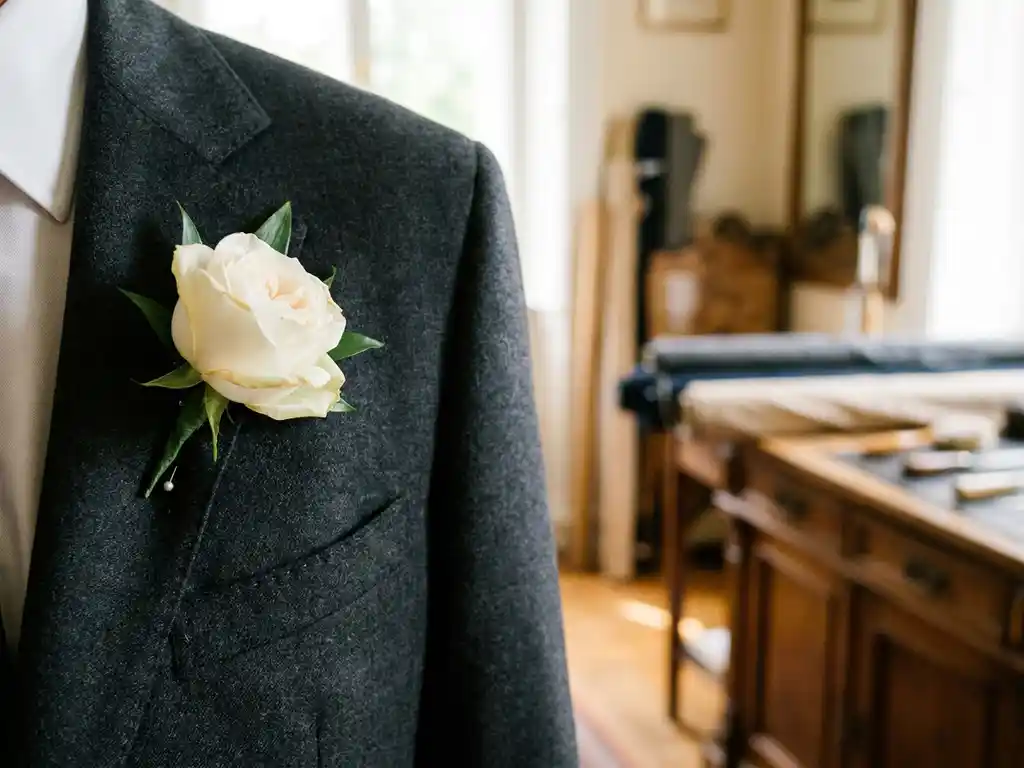
A boutonniere should be positioned on the left lapel of your wedding suit, approximately 4 inches below the shoulder seam and about half an inch from the lapel’s outer edge. The placement varies slightly depending on your lapel style, but the boutonniere should always sit flat against the lapel without pulling the fabric. Proper positioning enhances your formal wedding suit and complements the overall elegance of your wedding attire.
What exactly is a boutonniere and why does it matter on wedding suits?
A boutonniere is a small floral arrangement worn on the lapel of a suit jacket, traditionally by grooms, groomsmen, and other important male wedding guests. This classic accessory consists of one or more flowers, often complemented by greenery, ribbon, or decorative elements that coordinate with the wedding’s colour scheme.
The tradition dates back to medieval times, when knights wore flowers given by their ladies as tokens of affection and good luck. Over the centuries, this romantic gesture evolved into a standard element of formal menswear, particularly for special occasions like weddings. The boutonniere became a symbol of honour, distinction, and celebration.
For modern wedding suits, boutonnieres serve multiple important purposes. They add a sophisticated finishing touch that elevates the overall appearance of your formal wedding suit, creating visual interest and breaking up the solid lines of the jacket. The floral element introduces colour and texture, helping to tie together the wedding’s aesthetic while distinguishing key participants from regular guests.
Whether you’re wearing summer wedding suits in lighter fabrics or traditional formal wedding suits in classic colours, a well-placed boutonniere demonstrates attention to detail and respect for wedding traditions. It’s particularly meaningful for grooms, as it often coordinates with the bride’s bouquet, creating a visual connection between the couple.
Where should you position a boutonniere on your wedding suit lapel?
The correct position for a boutonniere is on the left lapel, approximately 4 inches below the shoulder seam and roughly half an inch from the lapel’s outer edge. This placement ensures the boutonniere sits in the most flattering position without interfering with the suit’s natural lines or your movement throughout the day.
The height positioning is particularly important for achieving the right look. Too high, and the boutonniere appears awkward and draws attention away from your face. Too low, and it gets lost among other accessories or interferes with pocket squares. The 4-inch measurement from the shoulder seam typically places the boutonniere at the widest part of the lapel, creating the most balanced appearance.
Distance from the lapel edge matters significantly for both aesthetics and practicality. Placing the boutonniere too close to the edge risks it catching on things or appearing precarious. Too far inward, and it looks cramped against the jacket’s button stance. The half-inch guideline provides enough space for the boutonniere to sit comfortably while maintaining its prominence.
For different suit cuts, you may need slight adjustments. Slim-fit wedding suits might require positioning the boutonniere slightly closer to the edge due to narrower lapels, while classic cuts offer more flexibility. Summer wedding suits in lighter fabrics may also need more careful positioning to avoid fabric puckering around the pin.
How do different lapel styles affect boutonniere placement?
Each lapel style requires specific boutonniere positioning to achieve the most flattering appearance. Notched lapels, the most common style on business and semi-formal suits, offer the most straightforward placement. Position the boutonniere above the notch, centred on the upper lapel section at the standard 4-inch measurement from the shoulder seam.
Peak lapels, often found on formal wedding suits and tuxedos, require more careful consideration. The upward-pointing peaks create strong vertical lines, so place the boutonniere slightly lower than you would on notched lapels to avoid competing with these dramatic angles. The boutonniere should sit in the smooth area between the peak and the jacket’s button stance, maintaining the lapel’s elegant proportions.
Shawl lapels present unique challenges due to their curved, continuous design without distinct sections. For these lapels, commonly seen on dinner jackets and some formal wedding suits, position the boutonniere where the lapel begins to curve back toward the jacket body. This placement follows the lapel’s natural flow while ensuring the boutonniere remains visible and properly secured.
Wedding suit colours can also influence optimal placement. Darker formal wedding suits provide more contrast for lighter boutonnieres, allowing for slightly more flexible positioning. Lighter summer wedding suits require more precise placement to ensure the boutonniere doesn’t get lost against the fabric colour.
Consider the lapel width as well. Wider lapels accommodate larger boutonnieres and offer more positioning flexibility, while narrow lapels on modern slim-cut suits require smaller boutonnieres placed with greater precision to maintain proportional balance.
What are the most common boutonniere placement mistakes grooms make?
The most frequent mistake is positioning the boutonniere too high on the lapel, often near the collar area. This placement looks awkward and draws attention away from the groom’s face. Another common error is placing it too low, where it interferes with pocket squares or gets hidden behind the jacket’s natural fold lines when moving.
Many grooms position their boutonnieres at an incorrect angle, either too horizontal or too vertical. The boutonniere should follow the lapel’s natural angle, typically sitting at a slight upward tilt that mirrors the lapel’s line. A completely horizontal placement looks unnatural, while an overly vertical angle appears forced and unstable.
Poor securing methods represent another significant mistake. Using pins that are too short or placing them incorrectly can cause the boutonniere to droop, spin, or fall off entirely. Some grooms use too many pins, creating visible puncture marks in their suit fabric, while others use too few, resulting in an insecure attachment.
Sizing mistakes are equally problematic. Oversized boutonnieres overwhelm the lapel and look disproportionate, especially on summer wedding suits with lighter fabrics. Conversely, boutonnieres that are too small get lost and fail to make the intended impact, particularly on formal wedding suits with wider lapels.
Coordination errors also occur frequently. Some grooms choose boutonnieres that clash with their wedding suit colours or fail to complement the overall wedding aesthetic. The boutonniere should enhance, not compete with, the suit’s appearance and the wedding’s colour scheme.
How do you properly secure a boutonniere to avoid damage to your suit?
Use a high-quality floral pin that’s long enough to go through the boutonniere stem, the lapel fabric, and the jacket’s canvas layer underneath. Insert the pin from the back of the lapel, push it through the boutonniere stem, then back through the lapel fabric. This creates a secure attachment without visible pinheads on the front of your suit.
The pinning technique requires careful attention to fabric protection. For delicate summer wedding suits in linen or lightweight wool, place a small piece of interfacing or fabric behind the lapel before pinning. This distributes the pressure and prevents the pin from creating permanent holes or tears in the fabric.
Consider the pin angle when securing the boutonniere. Insert the pin at a slight upward angle, following the boutonniere’s natural positioning. This provides better support and prevents the arrangement from drooping throughout the day. Avoid pinning straight across, as this can cause the boutonniere to rotate or shift position.
For expensive formal wedding suits or rental attire, magnetic boutonniere holders offer an excellent alternative to traditional pins. These accessories use strong magnets to secure the boutonniere without puncturing the fabric at all. Place one magnet behind the lapel and attach the boutonniere holder to the front, creating a secure hold that won’t damage the suit.
Test the security before the ceremony by gently tugging the boutonniere and moving normally. It should remain firmly in place without shifting or rotating. If you’re using traditional pins, ensure they’re fully inserted and that no sharp points are exposed that could catch on the bride’s dress during close contact.
After the wedding, remove the boutonniere carefully by supporting the lapel fabric while withdrawing the pin. This prevents stretching or tearing the material, which is particularly important for delicate fabrics used in summer wedding suits.
Getting your boutonniere placement right transforms your wedding suit from simply formalwear into a polished, traditional ensemble that honours wedding customs while showcasing your attention to detail. The right positioning enhances your overall appearance and ensures you look your absolute best for one of life’s most important occasions. When you’re ready to create the perfect wedding suit that complements your boutonniere beautifully, we’re here to help you achieve that flawless fit and timeless style that makes your special day even more memorable.
